


The short answer: a Somali wedding in the UK usually centres on the Islamic nikah and a large celebration, the aroos, with music, dancing, poetry and plenty of food. Families need a venue with space for big guest numbers, freedom to choose a halal caterer, no pressure to serve alcohol, and flexibility over seating. The Maher Centre at 15 Ravensbridge Drive, Leicester LE4 0BZ, seats up to 1,000 guests in one pillarless hall (1,500 standing), has a 350+ space free private car park, and beef and pork are not served on the grounds. Alcohol-free events are completely normal here.
Every family and region does things a little differently, and customs continue to evolve among Somali communities in Leicester, Birmingham, London, Bristol, Sheffield and beyond. Treat this as an introduction, and follow your own family's guidance.
What are the main Somali wedding traditions?
The proposal and family agreement
Marriage is traditionally a matter between families as well as the couple. The groom's family visits the bride's family to ask formally for her hand, and elders from both sides discuss and agree the arrangements. In some families, the groom's side presents gifts known as yarad to the bride's family, while the bride's family may give gifts, known as dibaad, to help set up the couple's home. Practices vary widely.
The nikah
The nikah is the Islamic marriage contract. It involves the consent of the bride, the involvement of her guardian (wali), witnesses, and the agreement of the meher (mahr), the gift from groom to bride. It is usually conducted by a sheikh, often at a mosque or at home, sometimes at the venue on the day of the celebration.
Henna night
Before the wedding, many brides have a henna gathering with female relatives and friends, with intricate designs on hands and feet, music and food.
The aroos
The aroos is the main wedding celebration: the bride and groom's entrance, music, traditional dancing such as dhaanto, songs and poetry, and a generous meal. Some families hold a mixed celebration; others hold separate gatherings for women and men, or a women-only party alongside a men's gathering. Brides often wear a white wedding dress for the aroos and change into traditional dress, such as the dirac or guntiino, later on or for other events.
Shaash saar
A few days after the wedding, many families hold the shaash saar, where married women of the family place a scarf (the shaash) on the bride's head, marking her new status as a married woman. It is often accompanied by buraanbur, women's poetry and song, and by blessings and advice from elders.
Xeedho
Some families keep the tradition of the xeedho: a decorated container of preserved meat and dates, wrapped and tied, which the groom's side must open without breaking the binding: a playful test of patience, accompanied by songs.
What does a Somali family need from a UK wedding venue?
Space for a big guest list
Somali weddings often welcome extended family and the wider community, and guest numbers can be very large. Ask how many guests the hall seats with a stage and a dance area in place, not just the standing capacity.
Halal catering of your choice
Food is central. Typical menus include bariis (spiced rice), goat or lamb (hilib ari), chicken, sambuusa, salads, fruit, xalwo (halwa) and spiced tea (shaah). You will want a caterer who knows Somali food and meets your halal standard.
No alcohol pressure
Somali weddings are typically alcohol-free. The venue should not expect a bar spend.
Flexible seating
Whether your aroos is mixed, separated or women-only, the hall should adapt easily.
Privacy for the bride
A private room for getting ready, resting and changing outfits.
Time to celebrate
Aroos celebrations often run late into the evening. Look for a long booking that includes supplier set-up and pack-down, so nothing feels rushed.
Parking
Large guest lists mean lots of cars, often from other cities.
How the Maher Centre hosts a Somali aroos
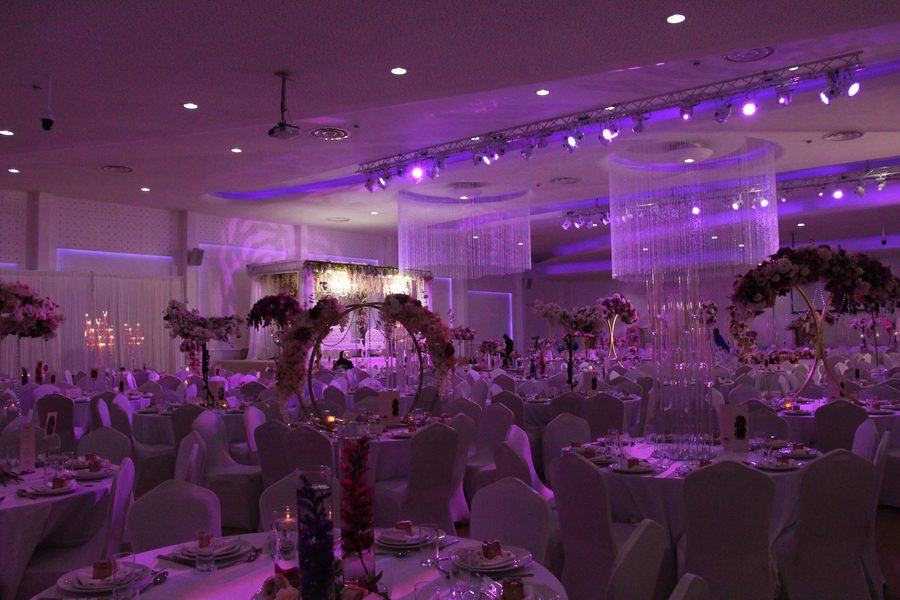
- Capacity: 1,000 seated banquet, 800 with a dance floor, 1,500 standing, in one pillarless 1,100m² hall, so no guest is sat behind a pillar.
- Catering: we do not provide catering. Choose a caterer from our partner network or bring your own Somali halal caterer. Beef and pork are not served on the grounds.
- Kitchen: an industrial kitchen with four burners, a free gas supply and refrigeration.
- Alcohol: the bar is entirely optional; alcohol-free events are completely normal.
- Seating: the open hall can be laid out for mixed, separate or women-only celebrations. Your décor partner can add screens or drapes.
- Dressing rooms: two private en-suite dressing rooms.
- Time: a full 12-hour booking including set-up and pack-down, so nothing ever feels rushed.
- Sound and light: full PA system and ambient LED lighting for music, dhaanto and buraanbur. Optional LED dance floor and screens.
- Parking: a 350+ space free, privately-owned floodlit car park with attendants: save a fortune on parking fines.
- Location: 5 to 10 minutes from M1 Junction 21, with easy reach from Birmingham, Nottingham, Coventry and Northampton.
Questions to ask any venue about a Somali wedding
- How many guests can you seat with our stage and a dance area?
- Can we bring our own halal caterer?
- Is non-halal meat ever served on the premises?
- Is there a minimum bar spend?
- Can the hall be set up for a women-only or separated celebration?
- Is there a private room for the bride?
- What time must we finish? Can it run later?
- How much parking is there, and is it private?
- Where can guests pray during the event?
- Can we book separate dates for the henna night or the shaash saar?
A sample aroos timeline
- Afternoon: caterer, décor and stage teams set up within the booking.
- Guests arrive: attendants direct cars; ushers seat guests.
- Bride's and groom's entrance with music and celebration.
- Meal service: bariis, meat dishes, sambuusa and sweets, with pauses for prayer as needed.
- Music, dhaanto and poetry, stage photographs with family.
- Close of the evening: supplier pack-down follows, and full clean-up is included.
Planning checklist
- Family agreement on functions and guest numbers
- Nikah arranged with the sheikh; civil registration checked with the register office
- Venue booked with seating, alcohol and food policies in writing
- Halal Somali caterer booked; menu and service style agreed
- Décor, stage, music and photography booked
- Running order with prayer times and entrances
- Directions and parking information sent to guests
A note on the law: in England and Wales, a nikah on its own is generally not recognised as a civil marriage unless formal requirements are met, so many couples also hold a register office ceremony. Check the current position with your local register office. Our Muslim wedding planning guide explains more.
See our Somali wedding venue page, the halal wedding venue guide, nikah venue and all our planning guides.
Frequently asked questions
What is an aroos?
What is shaash saar?
Can we hold a women-only aroos at the Maher Centre?
Can we bring our own Somali caterer?
How many guests can a Somali wedding at the Maher Centre hold?
Can the celebration run late?
Considering Maher Centre for your event?
Tell us your date, guest numbers and the functions you are planning. Our events team replies within one working day with availability and a written quote, and our price-match promise covers all packages and optional extras.
Get a quote → or WhatsApp us →